

The mere fact that the Supreme court took a January 6 case caused the trial judge to release the defendant early
Posted on | March 28, 2024 | No Comments
Aman convicted of charges related to the January 6, 2021, riot at the U.S. Capitol is getting out of jail early due to the Supreme Court taking up a case that may affect the sentences of hundreds of defendants.
Kevin Seefried, a man from Laurel, Delaware, was sentenced to three years in prison for a felony conviction of obstruction of an official proceeding, as well as 12 months and six months for misdemeanor charges. The Department of Justice said that Seefried, as well as his son Hunter, were among the first to enter the Capitol and were photographed carrying a Confederate flag while inside.
That case, Fischer v. United States, challenges the DOJ’s use of the “obstruction of an official proceeding” charge, which has been used against January 6 defendants for allegedly disrupting the Electoral College certification. After the Supreme Court agreed to hear arguments in the case, some defendants filed for release pending the final ruling.
According to court documents, McFadden determined that Seefried does not pose a flight risk or a danger to his community and that his appeal was not “for the purpose of delay and raises a substantial question” that is likely to result in a reversal, new trial, a noncustodial sentence, or a custodial sentence that will have ended by the time the appeal is decided.
He noted that at least four Supreme Court justices are interested in taking up the challenge to the DOJ’s obstruction charge use and that if the court rules In Fischer’s favor, “it will almost certainly mean that Seefried’s analogous conduct” did not violate the obstruction law.
“In that case, Seefried will be left serving only his sentences for the four misdemeanor convictions. But, by the time his appeal has concluded, those custodial sentences will have likely concluded,” he wrote.
Newsweek reached out to Seefried’s lawyer for comment via email.
The ruling comes just a week after a federal prosecutor warned that Jan. 6 defendants’ appeals based on Fischer could backfire.
U.S. Attorney Matthew Graves wrote in a court filing last week that if the Supreme Court sides with Fischer, the government could request consecutive, rather than concurrent, sentences for defendants’ misdemeanor charges, which in some cases may not necessarily result in a shorter prison sentence.
The filing states, “The calculus on resentencing would necessarily change, and a reversal of the 1512(c) conviction could increase the aggregate sentence on the remaining counts.”
McFadden addressed this concern in his ruling, criticizing federal prosecutors for relying on “the speculative claim that, without the felony conviction, the Court would convert Seefried’s concurrent sentences to consecutive ones.”
Comments
Leave a Reply
EVIDENCE AGAINST OBAMA — YouTube Indiana Trial of Obama !
Petition the White House to institute Edward Snowden, National Whistleblower – Patriots against Government Corruption Day

 OrlyTaitzEsq.com
TAITZ REPORT


Official Facebook
IMPORTANT NOTICES – PLEASE READ!
Historic DVD Now Available!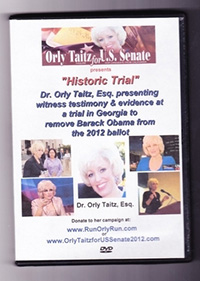 DVD of the historic trial in GA and DVD of a historic testimony in NH, where evidence was provided showing Obama using a forged birth certificate and a stolen social security number. The DVDs are in a beautiful commemorative case with personal autographs from attorney Dr. Orly Taitz $22.50 each +$2.50 for shipping and handling.
---------
To order these DVDs, donate $25.00 by credit card on the website RunOrlyRun.com and email orly.taitz@gmail.com with you name and address. Or send a $25.00 check with your name and address to: Orly Taitz for US Senate 2012, 29839 Santa Margarita ste 100, RSM, CA 92688.
DVD of the historic trial in GA and DVD of a historic testimony in NH, where evidence was provided showing Obama using a forged birth certificate and a stolen social security number. The DVDs are in a beautiful commemorative case with personal autographs from attorney Dr. Orly Taitz $22.50 each +$2.50 for shipping and handling.
---------
To order these DVDs, donate $25.00 by credit card on the website RunOrlyRun.com and email orly.taitz@gmail.com with you name and address. Or send a $25.00 check with your name and address to: Orly Taitz for US Senate 2012, 29839 Santa Margarita ste 100, RSM, CA 92688.
Advertisement / Sponsors
 29839 Sta Margarita Pkwy,
Ste 100
Rancho Sta Margarita, CA 92688
orly.taitz @gmail. com
(949) 766-7687

--------------------------------------
 Videography by Barbara Rosenfeld
--------------------------------------

Bumper Sticker
$9.99 thru PayPal--------------------------------------

--------------------------------------Orly Taitz Photo Collections