

I need Donofrio’s article on 16-351, i need tocheck something
Posted on | May 13, 2009 | 25 Comments
Category: Help Needed
Comments
25 Responses to “I need Donofrio’s article on 16-351, i need tocheck something”
EVIDENCE AGAINST OBAMA — YouTube Indiana Trial of Obama !
Petition the White House to institute Edward Snowden, National Whistleblower – Patriots against Government Corruption Day

 OrlyTaitzEsq.com
TAITZ REPORT


Official Facebook
IMPORTANT NOTICES – PLEASE READ!
Historic DVD Now Available!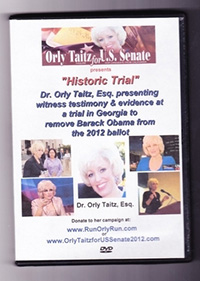 DVD of the historic trial in GA and DVD of a historic testimony in NH, where evidence was provided showing Obama using a forged birth certificate and a stolen social security number. The DVDs are in a beautiful commemorative case with personal autographs from attorney Dr. Orly Taitz $22.50 each +$2.50 for shipping and handling.
---------
To order these DVDs, donate $25.00 by credit card on the website RunOrlyRun.com and email orly.taitz@gmail.com with you name and address. Or send a $25.00 check with your name and address to: Orly Taitz for US Senate 2012, 29839 Santa Margarita ste 100, RSM, CA 92688.
DVD of the historic trial in GA and DVD of a historic testimony in NH, where evidence was provided showing Obama using a forged birth certificate and a stolen social security number. The DVDs are in a beautiful commemorative case with personal autographs from attorney Dr. Orly Taitz $22.50 each +$2.50 for shipping and handling.
---------
To order these DVDs, donate $25.00 by credit card on the website RunOrlyRun.com and email orly.taitz@gmail.com with you name and address. Or send a $25.00 check with your name and address to: Orly Taitz for US Senate 2012, 29839 Santa Margarita ste 100, RSM, CA 92688.
Advertisement / Sponsors
 29839 Sta Margarita Pkwy,
Ste 100
Rancho Sta Margarita, CA 92688
orly.taitz @gmail. com
(949) 766-7687

--------------------------------------
 Videography by Barbara Rosenfeld
--------------------------------------

Bumper Sticker
$9.99 thru PayPal--------------------------------------

--------------------------------------Orly Taitz Photo Collections







May 13th, 2009 @ 12:37 pm
Ask donofrio for it. He will give it to you. You can also talk to him and ask him questions.
May 13th, 2009 @ 12:50 pm
He has a few articles on that statute, but here’s one that might help you out:
https://naturalborncitizen.wordpress.com/2009/03/15/the-natural-born-citizen-blog-is-now-restricted/
May 13th, 2009 @ 2:28 pm
This one?
https://naturalborncitizen.wordpress.com/2009/03/04/quo-warranto-legal-brief-part-1/
May 13th, 2009 @ 2:37 pm
what you need can be found @ natural born citizen blog
May 13th, 2009 @ 2:43 pm
Donofrio’s site complete with archives. https://naturalborncitizen.wordpress.com/
May 13th, 2009 @ 2:52 pm
Orly,
Is this what you are looking for?
Donofrio’s article is reprinted at this site:
https://www.therightsideoflife.com/?p=3310
May 13th, 2009 @ 3:46 pm
What is 16-351 ??
May 13th, 2009 @ 5:34 pm
The Natural Born Citizen Blog Is Now Restricted
Posted in Uncategorized on March 15, 2009 by naturalborncitizen
There exists a statute enacted by Congress wherein it exercised Constitutional authority to challenge the credentials of, and/or remove, a sitting President found to be a usurper by failing to possess Article 2 Section 1 qualifications for holding the office of President of the United States. The Statute exists in the District of Columbia Code, the same Code which includes the United States Constitution.
District of Columbia Code Section 16-3501 states:
§ 16-3501. Persons against whom issued; civil action.
A quo warranto may be issued from the United States District Court for the District of Columbia in the name of the United States against a person who within the District of Columbia usurps, intrudes into, or unlawfully holds or exercises, a franchise conferred by the United States or a public office of the United States, civil or military. The proceedings shall be deemed a civil action.
This is the only statute in the entire body of United States federal law which specifically provides for removing all officers of the United States located in the District of Columbia, whether appointed or elected. In Article 1 Section 8 Clause 17, Congress was given broad sweeping authority over every possible legal case involving offices of the Government of the United States located in the District of Columbia. The office of President of the United States is in the District of Columbia and is certainly governed by the United States Constitution. Article 1 Section 8 Clause 17 states:
“The Congress shall have Power To… exercise exclusive Legislation in all Cases whatsoever, over such District (not exceeding ten Miles square) as may, by Cession of particular States, and the acceptance of Congress, become the Seat of the Government of the United States…”
Due to a little thing called “SEPARATION OF POWERS”, Congress is the only branch which has the authority to remove a sitting President. For a comprehensive review of this issue, please see my prior series of posts entitled, Quo Warranto Legal Brief: part 1, part 2, and part 3.
Since Barack Obama received the requisite number of electoral votes and has been sworn in as President, his eligibility for that office can only be challenged by Congress. Congress, via the DC Code quo warranto statute, has exercised that authority to challenge the sitting President’s eligibility by authorizing exactly one specific court – the District Court for the District of Columbia – with the power of carrying out the ministerial task of holding a trial of fact concerning questions as to the President’s eligibility to hold the office of President.
Section 16-3544 of the DC Code provides for a jury trial as to all issues of fact on this issue of Presidential eligibility. The provisions of 16-3502 also provide the only means available under the law where an action to challenge President Obama’s qualifications can be instituted without the acquiescence of any Judge or Justice. Every prior attempt to have this issue litigated has been squashed by a plethora of justices on grounds of personal standing, subject matter jurisdiction, or, as to SCOTUS, unknown reasons. So the DC Code should be the center of attention for all concerned about POTUS eligibility questions.
While there are many law suits pending in a multiplicity of jurisdictions around the United States, not one of those law suits has availed itself of the District of Columbia Code’s quo warranto statute, the only statute which specifically provides for a trial as to the issue of whether the President of the United States is eligible to the office of President.
Because all of these law suits are a distraction from the exclusive Constitutional means available to any new or pending litigant on this issue, I am restricting this blog’s content and all discussion therein to issues concerning the DC Code quo warranto statute and to issues concerning Constitutional qualifications for President.
I am doing this to keep the light shining on what I feel – as an attorney – is the very truth of the law. I have worked hard to gain people’s faith in my legal analysis, and I’ve tried to keep the discussion of this blog pure and free from spin and sensation so as to educate my readers as to the cold hard facts of the law and to its limitations which we must abide by if we are to preserve our Constitution.
Moreover, I have never taken any donations for this effort and I never will.
From now on, I will not allow comments to be posted which mention the names of, or which identify in any way with, law suits and/or attorneys, who refuse to acknowledge the applicable authority of the DC Code quo warranto statute. I wish the other attorneys no ill will. I
May 13th, 2009 @ 6:27 pm
Orly, see the attached link. I hope this helps you.
https://naturalborncitizen.wordpress.com/2009/03/04/quo-warranto-legal-brief-part-1/
May 13th, 2009 @ 8:22 pm
Donofrio was not happy with me doing gran juries and active military. He swings from side to side. I have no clue on which side he is now
May 13th, 2009 @ 8:22 pm
Here is another good starting point for reading:
https://naturalborncitizen.wordpress.com/2009/04/02/the-georgia-citizens-grand-jury-must-be-condemned/
May 13th, 2009 @ 9:35 pm
Everyone is trying to get to the same goal line. Why is collabortion so difficult for the end game.
I know egos run high in the legal profession, but enforcing provisions of the US Constitution is larger than all the egos put together.
Let’s get on the same team and support each other is this effort.
May 13th, 2009 @ 9:57 pm
Dr. Taitz, did you get the information that you were looking for? Or are you still looking for info. with regard to section 16-3501 of the D.C. Code?
May 13th, 2009 @ 10:24 pm
yes, thank you
May 13th, 2009 @ 10:26 pm
I tried.
May 13th, 2009 @ 11:21 pm
EVERY elected official who publicly fails to support efforts to at least force Obama to prove his constitutional eligibility is should be put on a list posted permanently on this website and no one should vote for them ever again. The list should be made public. We need to keep adding names. A major task no doubt. These elected officials are accountable to the people. If they don’t want to do their job then they should suffer at the polls. The only way they come of the list is if they change their mind and publicly demand an accounting from the fraud who sullies the White House. Orly can you get that list going? A second list should include judicial officers and sworn officers of the court who show disdain for our Constitution and the rule of law. Can you say Roberts? Holder? etc. Not only do we need to purge the impostor we need to purge those persons in government who fail to do their jobs! A big task no doubt, but we have to start cleaning up the mess now!
May 14th, 2009 @ 7:46 am
Hi Orly – I’ve been following this issue since the beginning from the UK, and following the various attorneys’ involved work including that of yourself.
Am I to read into this that you will be trying to move with quo warranto in the District of Colombia?
I can’t understand why this route has not been taken already given that appears to be where the remedy lies…
May 14th, 2009 @ 8:11 am
I sent yesterday what I could find on Donofrino’s site regarding your request. I see others have posted the same information but mine is “awaiting moderation”. May I ask why? I am a supporter of your efforts and have never posted anything negative anyplace!
May 14th, 2009 @ 2:32 pm
Actually, your James v Obama case is being filed in DC.
I thought it was odd otherwise! My apologies.
May 15th, 2009 @ 12:29 pm
Here is what L.D. Researched, and I happen to agree following up on his legal search.
“Chapter 35§ 16-3501 Persons against whom issued; civil action.
A quo warranto may be issued from the United States District Court for the District of Columbia in the name of the United States against a person who within the District of Columbia usurps, intrudes into, or unlawfully holds or exercises, a franchise conferred by the United States or a public office of the United States, civil or military. The proceedings shall be deemed a civil action.
The federal statute for quo warranto was tailor made by the legislature to challenge any person occupying any public office of the United States under questionable title thereto.
The applicable statute vests both officials with the same mutually exclusive authority to do so. The statute requires either/or, not both. Attorney General Eric Holder as well as to the US Attorney for the District of Columbia, Mr. Jeffrey Taylor.
The seminal SCOTUS case which has interpreted this statute is Newman v. United States ex Rel. Frizzell, 238 U.S. 537 (1915). The opinion is truly one of most rational and clearly written decisions in Supreme Court history and by itself serves as a thorough education on the history of quo warranto as well as the proper statutory interpretation. I suggest everyone read the entire case.
According to SCOTUS, Newman at 552, the statute applies to any public office:
The Revised Statutes declare that the District of Columbia shall be the seat of government, and “all offices attached to the seat of government shall be exercised in the District of Columbia.” The Code …provides that the… court shall have jurisdiction to grant quo warranto “against a person who unlawfully holds or exercises within the District a . . . public office, civil or military.” It was probably because of this fact that national officers might be involved that the Attorney General of the United States was given power to institute such proceedings…
…the District Code, in proper cases, instituted by proper officers or persons, may be enforceable against national officers of the United States. The sections are therefore to be treated as general laws of the United States, not as mere local laws of the District. Being a law of general operation, it can be reviewed on writ of error from this Court. American Co. v. Commissioners of the District, 224 U. S. 491; McGowan v. Parish, 228 U. S. 317.
Years later, any doubts as to the accuracy of this interpretation were completely nullified when current federal statute16-3501 revised the predecessor code to include officers of “the United States” and not just the District of Columbia.
Neither the statute nor any existing federal case provides an exception to the office of President or any public office of the United States.
CONCLUSION: An action in Quo Warranto is the statutory legal device available to challenge the eligibility of a sitting President.
B. Constitutionality of using the federal quo warranto statute to remove a sitting President.
There are two sections of the Constitution which allow for the removal of the President. Article 2, Section 4 allows for impeachment. This is the remedy for removal of the President should he partake in high crimes or treason. A quo warranto action as to POTUS eligibility does not appear to be covered by impeachment.
The second section of the Constitution which provides the removal of the President is Article 2, Section 1, Clause 6:
In Case of the Removal of the President from Office, or of his Death, Resignation, or Inability to discharge the Powers and Duties of the said Office, the Same shall devolve on the Vice President, and the Congress may by Law provide for the Case of Removal, Death, Resignation or Inability, both of the President and Vice President, declaring what Officer shall then act as President, and such Officer shall act accordingly, until the Disability be removed, or a President shall be elected.
Many have argued that only Congress can remove a sitting President and that the separation of powers enumerated in the Constitution denies the courts any legal ability to remove a sitting President. But with the federal quo warranto statute, Congress has delegated that authority to the District Court of the District of Columbia by providing for the removal of the President (and other public officers) by quo warranto where the President is found to be a usurper to the office even if he assumed the office with a good faith belief he was eligible.
Consider the following scenario: A quo warranto action is instituted by AG Holder or, in the alternative, US Attorney Taylor on their own motion. In that case, there must be a hearing on the merits (this will be explained in detail below). Further assume Obama then produces a perfect long form birth certificate proving he was born in Hawaii, but then the District Court of DC holds that since Obama was also a British subject at the time of his birth, he is not a “natural born citizen” and is therefore not legally occupying the office of President. Further assume that the DC District Court’s ruling is upheld by SCOTUS.
Under this fact pattern, Obama would not have broken any laws and so he couldn’t be impeached, but he would be removed from office pertaining to the removal authority of Congress enumerated in Article 2, Section 6, and so delegated by federal statute Chapter 35, §16-3501.
CONCLUSION: Congress has provided for the removal of a sitting President found to be ineligible by enacting the federal quo warranto statute .
Recall, Congress didn’t challenge Obama’s eligibility before he was sworn in, so those provisions are now moot. And once a person is sworn in as President, the Constitution then provides specific means for removing the President from office, none of which grant such power to the Judicial Branch. Now please consider the following two points:
Nowhere in the Constitution does it give the Judicial Branch the power to remove a sitting President.
Those who are currently petitioning the Judicial branch to challenge Presidential eligibility are seeking to subvert the Constitution.
They will argue Obama isn’t legally President and so therefore the Constitutional separation of powers can be “ignored”. Should a court ever accept that theory, you will have the recipe for civil war, and you will be doing more damage to the nation than you can even imagine.
Protest all you like, but the US Government recognizes his authority.
Furthermore, United States Courts all the way up to SCOTUS have refused to get involved, and this was the case before Obama was sworn in when the Judicial Branch actually did have the power to adjudicate the eligibility issue.
They punted!!! Fact!
Now that Obama has taken the office of President and is [officially recognized] as President, no court is going to suddenly take a leap around the separation of powers by agreeing the Constitution doesn’t apply to Obama as President.
That will never happen.
Let that sink in because it’s true, even if we don’t like it.
Nowhere in the Constitution does it say that impeachment is the sole means of removing the President.
Some who support Obama’s eligibility will seek to subvert the Constitution by arguing that the Constitution states that the sole remedy for removing the President is impeachment. Nowhere in the Document does it say that. Those who believe it must “imply” or “assume” that is the case.
But the Constitution does not state that impeachment is the sole means of removing the President.
The Constitution does say that Congress has the sole authority to impeach and the Senate to convict, and that the President “shall” be removed upon conviction, but it does not say that impeachment is the sole means of removal. You will hear people say that it does say that in the days ahead. It is a lie.
HYPOTHETICAL:
Two double agents born in the evil nation of “KILLAMERICASTAN” sneak a child into America over the Canadian border and later obtain false documents indicating they are US citizens and that their child was born in the United States. The child is raised like a Manchurian Candidate and believes his parents are US citizens and that he was born in the US.
The child grows up a gifted politician and eventually becomes President. After being sworn in, the truth is discovered by US Intelligence and proved beyond any doubt. The President then refuses to leave office since he didn’t do anything wrong and had no knowledge of the plot.
What happens?
Well, the President has done nothing to be impeached. He’s not guilty of any high crimes or misdemeanors, bribery or treason. Did the framers leave us naked in such a situation? I don’t believe so. We will return to this shortly.
We must respect the separation of powers or we will lose the Constitution and the Reblic for which it stands.
The separation of powers argument will be the proper undoing of every single POTUS eligibility law suit running through the courts at this moment in time. They will all fail. And they should, because for any of them to prevail, the separation of powers would be violated.
Even in law suits where federal courts have been petitioned to request Congress investigate – by way of mandamus – Obama’s eligibility (as opposed to seeking removal), the courts will dismiss on the basis of separation of powers limitations and/or subject matter jurisdiction, even if the plaintiffs were found to have passed the difficult standing tests (and that’s not going to happen either).
While I respect the litigants and the efforts they have made, I take issue with some of the tactics employed and I’m also not that impressed with many of the pleadings. I hope that, by publishing this brief, I will correct some of the previous errors and provide the public at large with the best possible education so that proper pressure can be applied to authorized Government officials.
IS THERE A CONSTITUTIONAL SOLUTION?
It appears there is a Constitutionally viable method available for the eligibility issue to be litigated which does not violate the separation of powers enumerated in the Constitution. I strongly believe the federal quo warranto statute provides the only Constitutionally viable means by which a sitting President can be removed from office if found to be a usurper, whether such usurpation is intentional or unintentional.
Full details and analysis below, but first let’s discuss the following:
REVIEW OF CURRENT QUO WARRANTO ACTIVITY
Only one attorney has filed for an actual quo warranto claim at this point in time. Unfortunately, that attempt will fail as it was brought on behalf of private plaintiffs.
As you will see below, any action in quo warranto must be brought on behalf of the [United States]!!!!
Another attorney has sent a “pre-litigation” letter to Attorney General Holder. But the statute requires a “verified petition” be forwarded to the Attorney General and/or the US Attorney requesting consent plaintiffs be allowed to institute a quo warranto action in the name of the United States. No such petition has been filed!!
Reason for currently ignored by them? Go figure, it is VERY SPECIFIC ON FILING… [and I am quite confident, they are highly being advised]….
In Newman v. United States ex Rel. Frizzell, 238 U.S. 537 at 546 (1915), the Supreme Court interpreted the role of the AG and US attorney as follows:
The District Code still treats usurpation of office as a public wrong which can be corrected only by proceeding in the name of the government itself. It permits those proceedings to be instituted by the Attorney General of the United States and by the attorney for the District of Columbia.
By virtue of their position, they, at their discretion and acting under the sense of official responsibility, can institute such proceedings in any case they deem proper. But there are so many reasons of public policy against permitting a public officer to be harassed with litigation over his right to hold office that the Code not only does not authorize a private citizen, on his own motion, to attack the incumbent’s title, but it throws obstacles in the way of all such private attacks.
It recognizes, however, that there might be instances in which it would be proper to allow such proceedings to be instituted by a third person, but it provides that such “third person” must not only secure the consent of the law officers of the government, but the consent of the Supreme Court of the District of Columbia before he can use the name of the government in quo warranto proceedings.
The modern federal statute is virtually identical except the US attorney has been included with the Attorney General as the two officials who may “at their discretion and acting under the sense of official responsibility… institute such proceedings in any case they deem proper.”
Such an action is so proper that despite which side of this argument you fall on, it should be obvious the nation would be better served by having this issue settled once and for all in open court… but not in the name of private plaintiffs who can be so easily painted as partisan.
If either official bring an action in quo warranto upon their own motion, such an action is brought on behalf of the United States and no leave of the court is necessary.
Comparatively, if a private attorney petitions these officials to allow them to bring suit in the name of the US “ex relator” then even if one of the two officials gives their consent, leave of the court must be requested and if denied, that’s it. The matter is done. One could then appeal to SCOTUS, but SCOTUS is the last resort, not the first. There’s no need to disrespect the statute and the resources of the court by going straight to SCOTUS. That’s just sensational, not wise.
Another interesting point to consider is that while the predecessor statute only named the District Attorney for the District of Columbia – the modern statute which controls quo warranto as to national officers mentions both the Attorney General and the “United States attorney”. As written, it’s possible any US attorney might be eligible to institute such a quo warranto action.
Notice that in the statute – “attorney” isn’t capitalized in either 16-3502 or 16-3503 when the “United States attorney” is mentioned. Of course, US Attorney Taylor is certainly authorized, but this needs further research.
Assuming AG Holder or US Attorney Taylor were to institute an action in quo warranto, the District Court might attempt to avoid a hearing on the merits (which every court of the nation seems hell bent upon avoiding) by claiming that the federal quo warranto statute – if applied to the President – would violate the Constitutional separation of powers and that they are of the opinion that the Constitution only allows removal of the President for impeachment.
If that argument can be overcome then, due to the obvious public policy benefits inherent in establishing that the President has a clear title to the office of President, there should be no obstacle preventing at least one of the two officials charged with the authority to act in the name of the United States to bring this issue to the court for the benefit of the nation.
The following points contain the most important issues as to federal quo warranto actions brought under the District of Columbia Code.
1. SCOTUS IS THE WRONG VENUE TO INITIATE AN ACTION IN QUO WARRANTO BECAUSE DOING SO WOULD DEPRIVE THE PUBLIC OF A JURY TRIAL ON THE ISSUE OF WHETHER OBAMA WAS BORN IN HAWAII.
The District of Columbia Code, Title 16, Chapter 35 (Quo Warranto) Subchapter III states: § 16-3544. Pleading; jury trial.
In a quo warranto proceeding, the defendant may demur, plead specially, or plead “not guilty” as the general issue, and the United States or the District of Columbia, as the case may be, may reply as in other actions of a civil character. Issues of fact shall be tried by a jury if either party requests it. Otherwise they shall be determined by the court. (Emphasis added.)
The quo warranto statute allows a jury trial on “issues of fact”. Whether Obama was born in Hawaii is an issue of fact. Whoever institutes a proceeding pursuant to the statute may request a jury trial and one must be granted. The judge could not refuses.
But if the case is brought to SCOTUS before it’s brought to the District Court of the District of Columbia, and if SCOTUS were to accept the case, you’re never going to have a jury trial.
Congress has absolutely no power to “interpret” clauses of the Constitution. That would be a violation of the separation of powers. Only the judicial branch could make such a determination. Congress properly assigned the issue to the District Court.
While Congress has the power to remove the President under the Constitution, they don’t have the power to interpret the Constitution. The judicial branch must do that.
As to issues of fact, ie:
– how long a person is a citizen of the US
– how old a person is
– where a person is born
…these qualifications for office are matters of fact which Congress properly recognized were best left to a trier of fact and therefore a trial by jury is statutorily allowed.
The issue of who is a “natural born citizen” under Article 2 Section 1 Clause 5 is an issue of legal interpretation outside the Constitutional authority of Congress.
Only the judicial branch can interpret the laws of this nation.
Congress didn’t delegate the authority to remove the President…they exercised that authority.
Under the statute, the DC District Court must follow the law enacted by Congress. Congress has deemed that if an action is instituted properly, the court then conducts a trial as to all relevant facts. After the facts are determined, the court is empowered under the Constitution, to interpret the law in light of the facts. JURY TRIAL. Think about that.
SCOTUS is not a trier of fact and so quo warranto MUST be brought before the District Court for the District of Columbia EXACTLY as the statute requires.
2. STANDING UNDER THE DISTRICT OF COLUMBIA CODE TO INSTITUTE A FEDERAL QUO WARRANTO ACTION
a. STANDING OF GOVERNMENT OFFICIALS
The DC code allows three different levels of standing to “institute” a quo warranto action. As to private plaintiffs, SCOTUS noted – in Newman at 538 – that Congress “has placed obstacles” in the way. But as to the “Attorney General” or the “United States attorney”, who act in the name of the United States, the statute makes it very simple for an action to be instituted. It says:
“The Attorney General of the United States or the United States attorney may institute a proceeding pursuant to this subchapter on his own motion…”
SCOTUS in Newman at 546 has interpreted the statute to give wide discretion to these officials:
“By virtue of their position, they, at their discretion and acting under the sense of official responsibility, can institute such proceedings in any case they deem proper.” “IN ANY CASE THEY DEEM PROPER.”
– There is no qualification that there be a certain amount of evidence one way or the other.
– There is no qualification that the officials must consider public opinion or political party affiliation.
– There is no “standing” to prove. If your title is US Attorney General or United States attorney, you have standing.
– There is no need to consult with Congress because, as SCOTUS noted in their opinion, Congress has already acted on the issue by enacting the quo warranto statute.
All that is required is that the official deems a quo warranto statute proper. His discretion is unassailable judicially.
The short answer is that the action is proper to settle title to the office of President for the good of the nation.
Even if both officials are convinced Obama is eligible, it’s still proper for them institute a quo warranto proceeding because the evidence emerging now is that, by leaving the controversy as is, a floodgate of litigation will ensue. And like the waters over New Orleans levees, this floodgate has the ability to wreak havoc on our nation.
Under the holding in ANDRADE v. LAUER, 729 F.2d 1475, 234 U.S.App.D.C. 384 (1984), the Court of Appeals for the District of Columbia has held that the defacto officer’s doctrine does not prohibit “collateral attacks” of official actions based upon a public officer’s lack of eligibility. These are not quo warranto suits to remove the official, they are civil suits to challenge a specific action of that official.
In the Andrade case, the plaintiffs were Government employees who lost their jobs to “reduction in force” ordinances which
cut whole departments from the Government budget. The plaintiffs sued alleging those who did the cutting were not Constitutionally qualified to make such decisions in that their appointments violated the appointments clause of the US Constitution.
The DC District Court held that the plaintiffs had no standing other than to bring a “direct attack” in quo warranto to remove the alleged usurper. But the DC Court of Appeals reversed and said the plaintiffs, who had suffered real injuries, could bring such an action on a case by case basis if they could prove their injury in fact (being fired) was caused by a Government official who was not eligible to serve.
They opened the door to a floodgate of litigation by an incredibly large field of possible plaintiffs who might challenge every single official action of the Obama administration on the basis that he isn’t eligible.
– Furthermore, there is a tenet of Government that requires there be a certainty to the official actions taken in the name of the United States. No certainty is possible when millions of US citizens, including active military, are concerned that Obama’s credentials were not verified in the same way all citizens must verify their identity for the most simple things in life like getting a drivers license or passport. It smacks of imperial coronation when a Government of, by and for the people are not entitled to know that the commander in chief must submit to the same levels of identity proof as the citizens.”
Let’s consider this, drop off all 300,000 plus currently filed petitions to both of them in their office, and not rely upon a few hundred phone calls. Not only would that be the correct manner of filing (a one shot deal), it would place them with the aforementioned method of filing.
I hope this helps with anyone wishing to contact their Senators with the understanding that somehow, they have the legal power to “do something” to remove a sitting President….. Sad fact, they don’t.
May 15th, 2009 @ 3:22 pm
Strunk v DOS and DHS DCD 08-cv-2234
DEFENDANTS’ ANSWER TO PLAINTIFF’S AMENDED COMPLAINT
Defendants the United States Department of State (“DOS”) and the United States Department of Homeland Security (“Dl-IS”) hereby answer Plaintiffs Aniended Complaint [Dkt. #9] in the following numbered paragraphs. which correspond to the Amendcd Complaint’s numbered paragraphs. Defendant denies each and every allegation contained in the Amended Complaint except as rnay be expressly admitted herein.
3. …Admit that Stanley Ann Dunham (“Dunham”). born on or about November 29, 1942, is deceased. Deny that Defendants have failed to fillfill their obligations under the FOIA. To the extent Plaintiff makes allegations regarding Barack H. Obama (**PresidenOt bama”). such allogations are subject to a pending motion to dismiss, and on that basis, Defendants deny. Nonetheless admit that President Obarna is a living natural person. born on August 4. 196 1. Defendants are without knowledge or information sufficicnr to form a belief as to the truth of thc remaining allegations in this paragraph.
5. Admit that plaintiff seeks relief under the FOIA and 28 U.S.C. $ 1651. Defendants deny that Plaintiff is entitled to relief.
20. Allegations concerning President Oba~nar e subject to a pcnding motion to dismiss. and no response is therefore required. To the estent this paragraph refers to a document, Defendants refer the Court to the document referenced as Eshibit H for a complete and accurate representation of its contents. To the extent this paragraph alleges that President Obama may be an illegal alicn or that President Obama is or ever was a citizen of Indonesia. those allegations are denied.
21. Defendants lack knowledge or information suflicient to form a belief about the truth of the allegations in paragraph 21 .
22. DHS denies that plaintiff submitted a FOlA request with U.S. Customs and Border Protection dated December 26, 2008. arid avers that it received a letter dated December 25. 2008, from Plaintiff. DHS refers the Court to the letter for a complete and accurate representation of its contents. DOS lacks knowlcdge or information sufficient to form a belief about the truth of the allegations in this paragraph.
26. Allegations concerning President Obama are subject to a pending motion to dismiss. and no response is therefore required. Further. Paragraph 26 contains conclusions of law, not factual allegations requiring a response and on that basis. Defendants deny. Nonetheless. admit that President Obama was elected President of the United States on November 4, 2008.
27. Denied.
28. Denied.
29. Allegations concerning President Obarna are subject to a pending motion to dismiss. and no response is therefore required. To the exten1 this paragraph alleges that President Obama is not a natural-born citizen of the Unitcd States, that allegation is denied. Further, Paragraph 29 contains conclusions of law, not factual allegations requiring a response. and on that basis. Defendants deny.
32. Allegations concerning President Obama are subject to a pending motion to dismiss. and no response is therefore required. To the extent this paragraph alleges that President Obama is not a natural-born citizen ofthe United States. the allegation is denied. The second sentence in this paragraph contains conclusions of la\v. not factual allegations requiring a response. and on that basis, Defendants deny.
33. Allegations concerning President Obalna are subject to a pending motion to dismiss, and no response is therefore required. To the extent this paragraph alleges that President Obama’s birth certificate has not been released to the public. that allegation is denied. To the estent this paragraph alleges that the birth certificate released to the public at the
direction of President Obama is not a valid birth certificate or that such certificate is not sufficient proof of U.S. citizenship. those allegations are denied.
34. Allegations concerning President Obania are subject to a pending motion to dismiss. and no response is therefore requircd. To the extent this paragraph allcges that the birth certificate released to the public at the direction of President Obama is not a valid birth certificate or that such certificate is not sufficient proof of U.S. citizenship. those allegations are denied. To the estent this paragraph alleges that President Obama is not a
natural-born citizen of the United States. the allegation is denied. Further. paragraph 33 contains conclusions of law. not factual allegations requiring a response. and on that basis. Defendants deny.
35. Allegations concerning President Obania are subject to a pending motion to dismiss, and no response is therefore required. To the extent this paragraph allcges that the birth certificate released to the public at the direction of President Obarna is not a valid birth certificate or that such certificate is not sufficient proof of U.S. citizenship, those allegations are denied. To the extent this paragraph alleges that President Obama is not a
natural-born citizen of the United States, the allegation is denied. Further, paragraph 35 contains conclusions of law. not factual allegations requiring a response. and on that basis. Defendants dcny.
36. Allegations concerning President Obama are subject to a pending motion to dismiss. and no response is tliercfore required. To the extent this paragraph alleges tliat President Obama is not a natural-born citizen of the United States, that allegation is denied. Specifically. Defendants deny that President Obama was born in Kenya or anywhere outside the state of Hawaii. Further. paragraph 36 contains corijecture as to possible facts and conclusions of law. not factual allegations requiring a response. and on that basis. Defendants deny.
37. Allcgations concerning President Obania are subject to a pending motion to dismiss. and no response is therefore required. To the extent this paragraph refers to a document. Defendants refer the Court to the document for a colnpletc and accurate representation of its contents. To the extent this paragraph allegcs that President Obama is not a natural-born citizen of the United States or that President Obama is or ever was a citizen of Indonesia. those allegations are denied.
38. Allegations concerning President Obama are subject to a pending motion to dismiss. and no response is therefore required. To the extent this paragraph refers to a document. Defendants refer the Court to the document for a complete and accurate representation of its contents. To the extent this paragraph alleges that Lolo Soetoro is or ever was
President Obama’s father by birth or adoption. tliat allegation is denied. To the extent this paragraph alleges that President Obama is or ever was a practicing Muslim. that allegation is denied.
39. Allegations concerning Presidcnt Obama are subject to a pending motion to dismiss. and no response is tlicrefore requircd. To the extent this paragraph alleges that President Obama is or evcr was an Indoncsian citizen, that allegation is denied.
40. Allegations concerning President Obama arc subject to a pending motion to dismiss. and no response is therefore required. ‘To the estcnt this paragraph alleges that President Obama is or ever was an Indonesian citizen. that allegation is denied.
40. Denied.
44. Allegations concerning President Obama are subject to a pending motion to dismiss. and no response is therefore required. To the extent this paragraph alleges that Lolo Soetoro is or ever was President Obania’s father by birth or adoption. that allegation is denied. Further. paragraph 44 contains conclusions of law. not factual allegations requiring a response, and on that basis. Defendants deny.
answered through paragraph 65 f amended complaint.
AFFIRMATIVE DEFENSES
I . Plaintiff has failed to exhaust his administrative remedies.
2. Records at issue are exempt or escluded from disclosure under the Freedom of Information Act.
3. Plaintiffs claims against DHS are moot.
4. The Amended Complaint fails to state a claini for ivliich relief can be granted.
5. Defendant DHS has not been properly served with process.
PRAYER FOR RELIEF
WHEREFORE, Defendants pray that the Court dismiss Plaintiffs suit with prejudice. render judgment that Plaintiff take nothing. assess costs against Plaintiff, and award Defendants all other relief to which they are entitled.
Always open for comments
Chris Strunk
http://www.strunk.ws
845-901-6767
May 16th, 2009 @ 10:08 am
William says:
Your comment is awaiting moderation.
May 15, 2009 at 12:29 pm
Last time it took 3 days awaiting comment moderation to finally post….
May 16th, 2009 @ 4:11 pm
sorry. I actually keep it aside because I wanted to be able to find it. Whe I release it from moderation, i can’t find it in thousands of comments. I thank you for the material and appreciate it.
May 18th, 2009 @ 9:14 am
Dr. Orly,
No problem, I understand and glad to be of any assistance. Having had my job cut last Sept and finding it difficult to get back into the workforce, gave me time to research the many legal cases over the last 6 months. It really has opened my eyes to our judical system, and I have learned quite a lot from a personal perpective.
May 18th, 2009 @ 10:03 am
you can e-mail me dr_taitz@yahoo.com