

Obama’s insane 1,5 trillion per year deficit and continued shipment of millions of American jobs to China made us another bankrupt Greece
Posted on | April 23, 2010 | No Comments
Greece asks for EU-IMF bailout

 Play Video AP – More Greek protests, EU says debt bigger
 Play Video
  AP – Stock price tickers flash green, indicating gains, at the Athens stock exchange on Friday, April 23, …
ATHENS, Greece – Greece asked Friday for the activation of a financial rescue plan by the eurozone and International Monetary Fund, in the hope it will help the heavily indebted country out of a major crisis and give it the breathing space to put its finances in order.
Prime Minister George Papandreou said financial-market pressure threatened to derail Greece’s economy with high borrowing costs, and that it was now “a national and pressing necessity for us to formally ask our partners for the activation of the support mechanism.”
“The moment has come,” Papandreou said, speaking from the remote Aegean island of Kastelorizo.
The plan agreed in Brussels recently would provide Greece with loans from other eurozone countries to the tune of euro30 billion ($40 billion) at interest rates of about 5 percent, and about euro10 billion from the IMF, in 2010. It aims to cover Greece’s immediate borrowing needs so it can continue servicing its debt and avoid default.
The bailout has to be reviewed by the European Union executive and the European Central Bank, and needs approval by all 15 of the other countries that use the euro.
A Greek government source said Athens was asking for the plan to be activated even though details are still being worked out.
“Negotiations are ongoing with the representatives of the IMF and ECB to determine the content and logistics of the plan,” the source said, speaking on condition of anonymity because of the sensitive nature of the issue.
“With the activation of this mechanism, we will have cast aside all doubts that we will face any difficulties with funding in the foreseeable future,” the source said. “There can no longer be any credible talk of default.”
With the details of the package still unclear, and several eurozone countries needing to have the issue approved by their parliaments, Greece will not receive cash immediately.
“Several days will pass before money can start being drawn,” Finance Minister George Papaconstantinou said in Athens, adding that the decision to ask for help was taken “following the events of the past few days,” particularly the upward revision of the country’s already large budget deficit and debt on Thursday.
The European Union’s statistics agency Eurostat on Thursday revised Greece’s budget deficit in 2009 to 13.6 percent of gross domestic product from 12.9 percent, and said it could be further revised by up to 0.5 percentage points. That, accompanied by Moody’s credit agency downgrading Greece’s sovereign rating, sent the country’s borrowing costs on the international markets spiraling to alarming and unsustainable levels: interest rates for Greek 10-year bonds reached nearly 9 percent.
In Washington, IMF chief Dominique Strauss-Kahn said the fund would move quickly on Greece’s request.
“We are prepared to move expeditiously on this request,” Strauss-Kahn said in a statement.
Spain, which is to contribute euro3.6 billion as part of the plan, welcomed Athens’ request for help and said the process would move quickly.
“Today we got the good news that Greece has asked for the aid that the EU has set aside and what we hope for is that the agreements of EU and IMF support are put into action as soon as possible so as to bring tranquility to the markets,” Deputy Prime Minister Maria Teresa Fernandez de la Vega said in Madrid.
“We’re all ready to put it into operation, in other words, we’re going to set it in motion as fast as possible,” she said, adding that the EU’s finance ministers will have to meet to set out the details and that Spain would have to take it to parliament for ratification to release its share of the funds.
The money from Spain, she said, “is there.”
In Berlin, spokesman for German Finance Minister Wolfgang Schaeuble, Michael Offer, stressed that once the Greek request was made, a group of experts, including the ECB and the IMF, would need to confirm whether Greece really needs the aid.
Offer said Schaeuble held a telephone conference Thursday with the Greek finance minister, among others, and that during the call, he insisted that Athens’ financial review, being conducted with the IMF, be completed “quickly.”
Offer sought to fend off domestic criticism from a German public concerned that their tax money is going to bail out another country.
“In Germany, we are required to act out of solidarity, and we will do that in order to stabilize the euro,” he said.
Frank Schaeffler, a member of parliament financial expert with the Free Democrats, told Germany daily newspaper Bild on Friday that “it is likely that Germany will have to provide more than euro30 billion in loans until the end of 2012. After that, it could be even more.”
Offer said the request was just the beginning of the process, and that Greece has to present a viable restructuring plan that requires approval of the ECB and the other institutes involved, including the IMF.
Pressed on how long this process could take, Offer said: “We don’t even know at this point how long the IMF mission will be conducting its review. The minister has voiced support for the process being as fast as possible. … So that trust of the Greeks themselves can be restored.”
Regarding German parliamentary approval for releasing the funds, Offer said he could not give any timeline. He underlined, however, that Merkel’s government — currently the majority in parliament — supports the Greek package.
Irwin Collier, an economy expert for North American at the John F. Kennedy Institute at the Free University, pointed out given that Merkel, who has backed the package, holds a majority in parliament.
“The fact that Merkel’s said she’s for it, simply means that it is going to come through, although not without some hefty debate,” Collier said.
Unlike France, Germany is not able to set up a supplementary budget, so it would finance its part of the bailout package through its KfW development bank, so the money will not come from the budget. Nevertheless, under German law, such a loan, regardless of how it is funded, requires parliamentary approval.
Comments
Leave a Reply
EVIDENCE AGAINST OBAMA — YouTube Indiana Trial of Obama !
Petition the White House to institute Edward Snowden, National Whistleblower – Patriots against Government Corruption Day

 OrlyTaitzEsq.com
TAITZ REPORT


Official Facebook
IMPORTANT NOTICES – PLEASE READ!
Historic DVD Now Available! DVD of the historic trial in GA and DVD of a historic testimony in NH, where evidence was provided showing Obama using a forged birth certificate and a stolen social security number. The DVDs are in a beautiful commemorative case with personal autographs from attorney Dr. Orly Taitz $22.50 each +$2.50 for shipping and handling.
---------
To order these DVDs, donate $25.00 by credit card on the website RunOrlyRun.com and email orly.taitz@gmail.com with you name and address. Or send a $25.00 check with your name and address to: Orly Taitz for US Senate 2012, 29839 Santa Margarita ste 100, RSM, CA 92688.
DVD of the historic trial in GA and DVD of a historic testimony in NH, where evidence was provided showing Obama using a forged birth certificate and a stolen social security number. The DVDs are in a beautiful commemorative case with personal autographs from attorney Dr. Orly Taitz $22.50 each +$2.50 for shipping and handling.
---------
To order these DVDs, donate $25.00 by credit card on the website RunOrlyRun.com and email orly.taitz@gmail.com with you name and address. Or send a $25.00 check with your name and address to: Orly Taitz for US Senate 2012, 29839 Santa Margarita ste 100, RSM, CA 92688.
Advertisement / Sponsors
 29839 Sta Margarita Pkwy,
Ste 100
Rancho Sta Margarita, CA 92688
orly.taitz @gmail. com
(949) 766-7687

--------------------------------------
 Videography by Barbara Rosenfeld
--------------------------------------
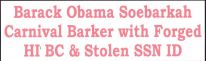
Bumper Sticker
$9.99 thru PayPal--------------------------------------

--------------------------------------Orly Taitz Photo Collections