

From a veteran Henry Tisdale
Posted on | October 19, 2009 | 3 Comments
| Henry Tisdale |
Submitted on 2009/10/19 at 10:41am
Way to Go, Vicki. That’s enough to cover 4 donations according to the 4000 @ $5 each. I can afford an additional one hundred above donation, and I am sure there are 199 more out there who can afford the same or more than that. Orly, paying off that crazy judge is a piece of cake. But I also am gonna resend my letter to him, and copy the Bar with which he is registered, plus the Gov, the GA Senators and Land’s representative will also get copies. Judge Land is guilty of treason against the constitution and somewhere there exists the power to make him pay. We are all still Americans, and Obama and Soros had better put up their dukes for a REAL FIGHT. Stealing our sovereignty is NOT a piece of cake and they both will soon realize it. So let’s sit back wait for Judge Carter to flex his Marine muscles again. I still have faith in him. I have tons of faith in you, my Captain. |
loved the message in the “Purpose for donation” column 0 # |
Comments
3 Responses to “From a veteran Henry Tisdale”
EVIDENCE AGAINST OBAMA — YouTube Indiana Trial of Obama !
Petition the White House to institute Edward Snowden, National Whistleblower – Patriots against Government Corruption Day

 OrlyTaitzEsq.com
TAITZ REPORT


Official Facebook
IMPORTANT NOTICES – PLEASE READ!
Historic DVD Now Available!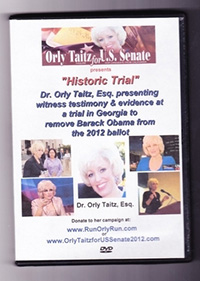 DVD of the historic trial in GA and DVD of a historic testimony in NH, where evidence was provided showing Obama using a forged birth certificate and a stolen social security number. The DVDs are in a beautiful commemorative case with personal autographs from attorney Dr. Orly Taitz $22.50 each +$2.50 for shipping and handling.
---------
To order these DVDs, donate $25.00 by credit card on the website RunOrlyRun.com and email orly.taitz@gmail.com with you name and address. Or send a $25.00 check with your name and address to: Orly Taitz for US Senate 2012, 29839 Santa Margarita ste 100, RSM, CA 92688.
DVD of the historic trial in GA and DVD of a historic testimony in NH, where evidence was provided showing Obama using a forged birth certificate and a stolen social security number. The DVDs are in a beautiful commemorative case with personal autographs from attorney Dr. Orly Taitz $22.50 each +$2.50 for shipping and handling.
---------
To order these DVDs, donate $25.00 by credit card on the website RunOrlyRun.com and email orly.taitz@gmail.com with you name and address. Or send a $25.00 check with your name and address to: Orly Taitz for US Senate 2012, 29839 Santa Margarita ste 100, RSM, CA 92688.
Advertisement / Sponsors
 29839 Sta Margarita Pkwy,
Ste 100
Rancho Sta Margarita, CA 92688
orly.taitz @gmail. com
(949) 766-7687

--------------------------------------
 Videography by Barbara Rosenfeld
--------------------------------------

Bumper Sticker
$9.99 thru PayPal--------------------------------------

--------------------------------------Orly Taitz Photo Collections







October 19th, 2009 @ 12:12 pm
Dr, Thanks for keeping up with the good fight!! I too donated what I can to the Asinine Sanction Fund. God Bless
Dave.
October 19th, 2009 @ 2:36 pm
I just sent a check for $200.00. Our forefathers sacrificed with their lives to Defend Our Freedoms. Can we not sacrifice by brown-bagging it once in a while. Maybe a cup of coffee at work-free-instead of Starbucks. It adds up. Maybe then you’ll have something to send. Doesn’t seem fair that Orly,or her clients , should bare the whole burden.
October 19th, 2009 @ 2:45 pm
Judge Land is not the only one playing games. This is from American Grand Jury at their website – amgjnow.org – confronting judge Lamberth for, I suspect, playing the same games. It may be an advantage for Orly and everyone else to some way to work with American Grand Jury;
(AGJ response to Lamberth’s Order #2)
UNITED STATES DISTRICT COURT
FOR THE DISTRICT OF COLUMBIA
In Re: Super American Grand Jury
Re: ORDER, Dated Sept. 10, 2009
Issued by the Honorable
Royce C. Lamberth
Chief Judge
United States District Court
Misc. No. 09-346 (RCL)
Response to Court Order
American Grand Jury [hereinafter “AGJ”] hereby files this “Response to Court Order” before the United States District for the District of Columbia in response to the Order [hereinafter “Order”] issued by Judge Royce C. Lamberth on September 10, 2009 in re: Super American Grand Jury.
Introduction
On September 10th, 2009 this Court issued an Order with regard to the pending AGJ Presentments served upon the Court. The Court dated its Order on September 10th, 2009, however, the Court did not publish or send the Order to AGJ until the 3rd week in September.
AGJ responds with the following arguments based on the Court’s stipulations in the Order:
Arguments
The Court stipulated in the Order that:
“Petitioner’s Motion for Reconsideration is hereby GRANTED and they are given leave to file their ‘presentments’ upon tendering the filing fee to the Clerk of the Court..”
Response by AGJ: In the above stipulation, the Court has completely misinterpreted the mission of this Grand Jury. AGJ is NOT filing anything. We are a Grand Jury. We are not a plaintiff, a petitioner or a party to any lawsuit. The Presentments have been served upon this Court. As such, this Court should not attempt to diminish the importance of AGJ’s actions by suggesting they must “file” their Presentments or “tender” a fee to the Court. This is absolutely outrageous and out of the question. The Presentments before the Court are legal and binding. The Presentments MUST be accepted and acted upon by the Court.
The Court further stipulated:
“..however, should the fee be tendered the Presentments will be dismissed as the petitioners lack standing to enforce the criminal laws of the United States.”
Response by AGJ: This is a “play on words” by the Court. By using the word “petitioners” the Court is trying to imply that the standing of the Grand Jury is merely that of a petitioner, plaintiff or party to a lawsuit. This implication is, of course, not true.
The Court suggests that AGJ lacks standing to enforce the criminal laws of the United States of America. This statement by the Court is misleading. Without question AGJ has standing but not to enforce criminal laws. We are a Grand Jury tasked with the job of reviewing and voting on criminal evidence and handing down Presentments. It is the Court’s job to prosecute and enforce the criminal laws.
The Court made an extremely prejudicial statement when they declared they would dismiss the Presentments if filed. For a Court to make such a statement prior to reviewing the evidence and criminal charges is inflammatory and tantamount to “Obstruction of Justice.”
Standing: When a crime is committed where such action expressly violates the Constitution, then first, there must be a determination if such action was unconstitutional; if it was, then all citizens should have standing by virtue of the 9th Amendment, which expressly reserves to “We the People” any right not specified in the Constitution. And since there is no right granted in the constitution, for any branch [or person] to violate the constitution, the people retain the right to see that it [the Constitution] is enforced.
Article III Courts cannot abdicate their own Jurisdiction. The United States District Court for the District of Columbia is an Article III Court. Jurisdiction extends to any Article III Court as follows:
Article III, Section 2 of the United States Constitution
The judicial Power shall extend to all Cases, in Law and Equity, arising under this Constitution, the Laws of the United States, and Treaties made, or which shall be made, under their Authority..
The “shall extend to all Cases” is a mandatory statement, as much as it is a universal one. If the Court refuses to extend its jurisdiction to all Cases, then it is acting unconstitutionally. The “arising under this Constitution”, clearly explains that it is the duty of the Court to uphold the Constitution.
For the Court to refuse to uphold the Constitution, for any reason whatsoever, is innately unconstitutional, because it directly contradicts the duty of the Article III Judiciary.
It is worth keeping in mind the words of U.S. Supreme Court Chief Justice John Marshall when he wrote in Cohens v. Virginia 19 US 264 (1821):
“It is most true that this Court will not take jurisdiction if it should not: but it is equally true, that it must take jurisdiction if it should. The judiciary cannot, as the legislature may, avoid a measure because it approaches the confines of the constitution. We cannot pass it by because it is doubtful. With whatever doubts, with whatever difficulties, a case may be attended, we must decide it, if it be brought before us. We have no more right to decline the exercise of jurisdiction which is given, than to usurp that which is not given. The one or the other would be treason to the constitution. Questions may occur which we would gladly avoid; but we cannot avoid them. All we can do is, to exercise our best judgment, and conscientiously to perform our duty..”
And finally, the Court stipulated:
“The question of whether and when prosecution to be initiated is within the direction of the Attorney General.”
Response by AGJ: If the Court is stating that the Attorney General shall have the right [“direction”] to decide prosecution concerning the AGJ Criminal Presentments, then that assertion is unconstitutional. This Court cannot abdicate its power or jurisdiction. The Attorney General is an “appointee” of the Administration. As such, the Attorney General has no authority over the Judicial Branch of Government in deciding whether the AGJ Presentments can be prosecuted.
We must remind the Court that 273 jury members comprised of “We the People” handed down the AGJ Presentments. These Presentments are Constitutional in nature and should be protected and preserved under the laws of that Constitution. Furthermore, these Presentments specifically charge Barack Obama with violating the laws of the Constitution. The Attorney General is an “appointee” of Barack Obama. The mere suggestion that such an “appointee” can decide the fate or prosecution of Mr. Obama is without question a serious conflict of interest. The “separation of powers” between the Judiciary and Executive Branch are guaranteed and protected under the supreme law of the land. This Court should not, under any circumstances, violate those sacred powers.
This Article III Court has the complete authority and standing to prosecute the charges handed down in the AGJ Presentments. For this Court to not do so would be a gross dereliction of its “sworn” duty to protect and defend the Constitution and the People.
Summary
The Court made various stipulations in the Order. All stipulations were based on assumptions that were misleading or materially false.
1) The Court tried to imply AGJ was a petitioner or party to a lawsuit subject to filing restrictions and fees. This is not true. AGJ’s Presentments are criminal charges. Such Presentments were “served” upon the Court. These Presentments have now become the responsibility of the Court to review and prosecute the named defendants if the charges are deemed credible.
2) The Court then suggested AGJ lacked standing to enforce the criminal laws of the United States of America. This statement by the Court it misleading. AGJ certainly has standing but not to enforce criminal laws. We are a Grand Jury tasked with the job of reviewing and voting on criminal evidence and handing down Presentments. It is the Court’s job to prosecute and enforce the criminal laws. The true standing is vested in the Constitution and with “We the People.” Once the Presentments are handed down, it is the duty of the Court to proceed.
3) The Court made an extremely prejudicial statement when they declared they would dismiss the Presentments if filed. That statement is an attack on the Constitution and the People. For a Court to make such a statement prior to reviewing the evidence and criminal charges is tantamount to “Obstruction of Justice” and possibly “Misprision of Treason or Felony.” The Court, its Judges, and employees cannot in good faith serve the Constitution or the People by refusing to do their jobs if they in anyway try to hide, ignore or fail to investigate criminal Grand Jury charges placed before them.
4) Finally, the Court suggested the Attorney General was the only person to direct a criminal prosecution within this Court. This is absolutely ridiculous. This is an Article III Court. This Court is well within its responsibility and jurisdiction to prosecute a criminal case against the defendants named in the AGJ Presentments. Why would the Court even consider seeking the advice of the Attorney General when convening a prosecution against Barack Obama? Barack Obama appointed the Attorney General. The Attorney General has a major conflict of interest here.
Conclusion
It is time for the Court and the Honorable Judge Royce C. Lamberth to stop handing down Orders that avoid the real issues at hand. This Country is suffering from a major Constitutional crisis. The People are aware of the fact that the Court is dragging its feet. Should the Court fail to act the situation is only going to get worse. The Constitution provides the People with a direct means of addressing grievances and “ferreting out” criminal violations of the Constitution. That means is the Grand Jury process. This Court needs to act by reviewing the evidence and charges handed down in the AGJ Presentments. Once the evidence is found credible, the Court needs to indict and prosecute the defendants. Refusing to act is no longer an option.
Respectfully executed this _____ day of October, 2009 by Robert J. Campbell and Mack Ellis.
Copyright © American Grand Jury 2009, All rights reserved.