

If you are going into foreclosure, we might be able to help. Call 949-683-5411
Posted on | September 28, 2009 | 4 Comments
I am attaching a college application essay by Charlie Lincoln, son of Charles Lincoln, Harvard educated PhD and JD from University of Chicago and a former clerk for 2 federal judges (including judge Reinhart from 9th Circuit court of appeals). Mr. Lincoln is advising me in both Obama eligibility and real estate matters.
Charlie the 4th took College AP courses at Harvard this summer together with my youngest son Ron. I thought you may want to read his essay- it provides an insight to today’s real estate crisis. Charles and Elena Lincoln should be very proud of such a bright young man. (My husband and I are also very proud of Ron who aced Macro and Micro Economics at Harvard at age 15)
The Mortgage Crisis and Monetary Policy
Charles Edward Lincoln, IV
My dad is a real estate management consultant with a J.D., and this past summer (2009) I got a firsthand look at what his trusteeship and advocacy organization (Tierra Limpia/Deo Vindice Foundation) does in trying to help people keep their homes in the face of the national foreclosure crisis/epidemic hitting the United States for the past two years. I don’t know where to begin except that I think I began to understand a little bit about money and homeownership over the summer, what it is and how it works, and it made me very interested in economics, which is not something I had ever really thought about before.
I suppose everybody has the idea that money is something fixed, tangible, and “real” in some way, and that money is just a medium of exchange that is used to buy things, like houses, like cars, like almost everything we have. Last summer I learned a very different perspective on exactly how money works and what the relationship between money and property really is. My parents both have Ph.D.s in Anthropology with specialties in Archaeology/Ethnohistory, so (obviously) I know that not all societies have anything remotely like what we call “money” and that “money” in fact is a relatively recent invention in cultural evolution/human history.
Homes of course, have a very, VERY long history in cultural evolution and human history, and it could be said that the increasingly “fixed” nature of the nightly sleeping place was part of what made humans “human” during the 3-5 million years or so between the earliest identifiably Hominoid ancestors and fully modern Homo Sapiens sapiens (Linnaeus).
What I learned from my dad over the summer, and what makes me think that I should study economics, is that HOMES are MONEY and MONEY is MADE FROM HOMES. Obviously, it’s not quite that simple, but Dad says that that the economy of the United States of America really doesn’t produce anything anymore EXCEPT HOMES and MONEY—and that’s sad because America in the 19th century was probably the invention center of the world and in the 20th century (at least up through the 1960s) was still the manufacturing and production center of world. But then Henry Kissinger and Nixon went to visit the Chinese Communists, and now the Chinese Communists are the leading capitalists (well, at least the leading manufacturers) in the whole world.
Money apparently comes into existence very systematically through loan applications. I guess I always just thought that the government authorized a certain amount of money to be printed and that’s how we get money. But instead, it turns out that money is a reward for productivity, or at least for maintaining the façade or semblance of productivity that well-behaved social conformity can apparently create: the more you conform to certain norms of money-management, credit handling, and “work ethic”, the more money you get—at least until the economy goes haywire like it did over the past ten years. Then EVERYBODY gets money whether they are productive social conformists or not. Politicians apparently do this as a way of buying votes and lulling people into somnolent catatonia where they really have no idea just how bad off they are, with their money being completely worthless and their homes being bigger and better and ever increasingly expensive in about the direct proportions (but opposite directions).
Now what money is came as a big shock to me, also. “Money” is nothing but a “promise to pay” which by law must be accepted as a “tender” (i.e. offer) of payment. Money itself is just (intrinsically) worthless paper. But the money we put in our pockets and bank account ledgers all takes the form of “notes”, and all “notes” are basically “promises to pay.” However, and this is where my Dad’s J.D. comes in handy, “notes” or “promises to pay”, when accepted by a National Banking Associations, are actually defined by law (Title 12 of the United States Code, Section 1813l) as “deposits in money.”
What this means is that when a National Banking association accepts a note, say, for a house worth $500,000.00, they are required by Federal law to itemize this on their “dual entry” ledger of assets and liabilities as an “asset” which is to say a “deposit” of $500,000.00. Ironically, if a person comes into the bank with $500,000.00 in actual money, this sum must be listed on the bank’s dual entry accounting ledger as a “liability” for the simple reason that a deposit in cash must be repaid upon demand, while a “note” deposit will never be repaid: it becomes part of the Bank’s “Wealth” until it is returned or canceled upon final payment (but by then the bank has received payments of the principle amount of the note plus interest, which interest may amount, over 30 years, to 2-4 times the face value of the note).
I have come to understand that, in essence, credit extended by modern versions of traditional commercial paper has taken the place of “capital” as the motivating and controlling factor in the control and impulse of production in the modern world. Struggles over the establishment, extension and expansion of personal and consumer credit shaped the growth and development of society during the 20th century from “progressive liberalism” of William Jennings Bryan and Lloyd George. Metal-standards of currency (e.g. gold and sterling silver) were abandoned in favor of credit standards based on production, measured through income tax and contributions to programs such as social security, which seemed likely to measure both individual ability and need simultaneously. Thus it is that Karl Marx’ 1875 restatement of Christian sharing first articulated in Acts 4:32-35, “from each according to his ability to each according to his need” became the motto of the modern redistributive socio-political order, even as communism itself was rejected.
In the United States and England, early 20th century governmental monetary and public-credit policies were synonymous with the planting of the seeds, which ultimately grew into the modern welfare state. In the 1930s, the credit-inflationary economics of John Maynard Keynes took both the U.K. and U.S. by storm after the stock market crash of 1929 and in particular the election of Franklin Delano Roosevelt, and has basically dominated the economic policies of Western European and the Western Hemisphere generally up until the present time.
The conflict (the Hegelian “contradiction in all things”) which led to the current mortgage crisis, it seems to me, is that which has arisen is between private corporate interest in credit and welfare and the governmental policies of privatization coupled with “deregulation” of financial responsibility and “credit reserve” laws defining standards for “purchase on margin” or “minimum downpayment” requirements for the purchase of securities or other types of property (such as real estate) on credit. Such standards were in fact imposed in 1933-34 as part of the adoption of Keynesian inflationary economics in the United States, via the enactment of the Securities and Exchange laws relating specifically to the issuance and marketing of “notes.” The coupling of “deregulated” private bank credit lacking marginal reserve or downpaymentrequirements withgovernmental stimulus policies aimed to compensate for the lack of productivity, declining tax revenues, etc., has had the effect of setting up the economy analogous to a car on high acceleration with no brakes or steering wheel.
Comments
4 Responses to “If you are going into foreclosure, we might be able to help. Call 949-683-5411”
EVIDENCE AGAINST OBAMA — YouTube Indiana Trial of Obama !
Petition the White House to institute Edward Snowden, National Whistleblower – Patriots against Government Corruption Day

 OrlyTaitzEsq.com
TAITZ REPORT


Official Facebook
IMPORTANT NOTICES – PLEASE READ!
Historic DVD Now Available!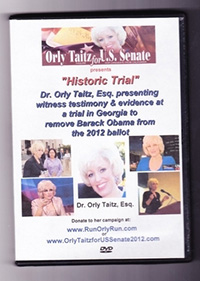 DVD of the historic trial in GA and DVD of a historic testimony in NH, where evidence was provided showing Obama using a forged birth certificate and a stolen social security number. The DVDs are in a beautiful commemorative case with personal autographs from attorney Dr. Orly Taitz $22.50 each +$2.50 for shipping and handling.
---------
To order these DVDs, donate $25.00 by credit card on the website RunOrlyRun.com and email orly.taitz@gmail.com with you name and address. Or send a $25.00 check with your name and address to: Orly Taitz for US Senate 2012, 29839 Santa Margarita ste 100, RSM, CA 92688.
DVD of the historic trial in GA and DVD of a historic testimony in NH, where evidence was provided showing Obama using a forged birth certificate and a stolen social security number. The DVDs are in a beautiful commemorative case with personal autographs from attorney Dr. Orly Taitz $22.50 each +$2.50 for shipping and handling.
---------
To order these DVDs, donate $25.00 by credit card on the website RunOrlyRun.com and email orly.taitz@gmail.com with you name and address. Or send a $25.00 check with your name and address to: Orly Taitz for US Senate 2012, 29839 Santa Margarita ste 100, RSM, CA 92688.
Advertisement / Sponsors
 29839 Sta Margarita Pkwy,
Ste 100
Rancho Sta Margarita, CA 92688
orly.taitz @gmail. com
(949) 766-7687

--------------------------------------
 Videography by Barbara Rosenfeld
--------------------------------------
Bumper Sticker
$9.99 thru PayPal--------------------------------------

--------------------------------------Orly Taitz Photo Collections







September 28th, 2009 @ 10:12 am
Dr. Orly – How can you help me avoid foreclosure? Will Dr. Lincoln be doing the work through his companies? Please let me know.
September 28th, 2009 @ 10:18 am
Well, ‘money’ as a medium of exchange is exactly what it is and only is. Homes are wealth, just like harvested wheat, cattle, mines, etc. It’s the confusion between the two that causes the trouble – and it’s a deliberate confusion on the part of those who wish to cheat the populace.
If ‘money’ was equatable to ounces of gold, i.e. not dollar bills but bills with printing on them that they were worth .1 ounce of gold, .2 ounces of gold, etc. then the real relationship would become more clear.
Yes, true wealth is not the gold, although as a metal gold has value and it can be used for ‘money’; but gold standards correctly set up so the ‘money’ directly reflects the amount of gold, and not the other way around, are viable because there is only a limited amount of gold and it can not be artificially produced. Gold standards simply put a cap on the amount of ‘money’ that can be printed and help keep the powers that be sane, unlike systems that use creative accounting systems like the Fed.
September 28th, 2009 @ 11:57 am
I will be doing the work. Mr. Lincoln assists me in research
September 28th, 2009 @ 2:26 pm
Dr. Taitz:
I learned from Robert Kiyosaski (Author of Rich Dad Poor Dad) that the best investment of all is real estate. I just finished my session with the Rich Dad’s personal coaching program and learned alot about how to build a real estate team when purchasing a property for rent. I bought a new house in TN this summer and now someone recently moved in. Since you are involved in real estate, I want to know if it is a good time to acquire several properties during this ecomonic crisis.
Dr. taitz, I want to THANK YOU for your willingness to help restore America while in process of removing the usurper from POTUS. I have been reading all comments in your blogs daily as I am looking forward to the day when the usurper is forced out of the White House. This will be a huge VICTORY for America because of you. I as well as all your supporters are praying for you and your family daily that God will give you wisdom when you are in the courtroom before Judge Carter. I also am praying that he will make the right decision on October 2 and 5. Thank you billions times for your hard work and patience. You are the Lady Liberty just like the Statue of Liberty near NYC. I am very proud of you as real American hero.
Thanks. May God bless you abundantly.
Anne