

Does your municipality of state allow private attorney to sue on behalf of the city or state?
Posted on | May 16, 2009 | 5 Comments
Please, check your local municipal and state statutes. Some states allow private attorneys to prosecute on behalf of the State or municipality. Let me know if you find something like this in your city or state codes. e-mail me at dr_taitz@yahoo.com
Category: Uncategorized
Comments
5 Responses to “Does your municipality of state allow private attorney to sue on behalf of the city or state?”
EVIDENCE AGAINST OBAMA — YouTube Indiana Trial of Obama !
Petition the White House to institute Edward Snowden, National Whistleblower – Patriots against Government Corruption Day

 OrlyTaitzEsq.com
TAITZ REPORT


Official Facebook
IMPORTANT NOTICES – PLEASE READ!
Historic DVD Now Available!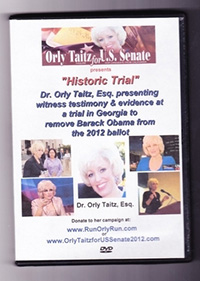 DVD of the historic trial in GA and DVD of a historic testimony in NH, where evidence was provided showing Obama using a forged birth certificate and a stolen social security number. The DVDs are in a beautiful commemorative case with personal autographs from attorney Dr. Orly Taitz $22.50 each +$2.50 for shipping and handling.
---------
To order these DVDs, donate $25.00 by credit card on the website RunOrlyRun.com and email orly.taitz@gmail.com with you name and address. Or send a $25.00 check with your name and address to: Orly Taitz for US Senate 2012, 29839 Santa Margarita ste 100, RSM, CA 92688.
DVD of the historic trial in GA and DVD of a historic testimony in NH, where evidence was provided showing Obama using a forged birth certificate and a stolen social security number. The DVDs are in a beautiful commemorative case with personal autographs from attorney Dr. Orly Taitz $22.50 each +$2.50 for shipping and handling.
---------
To order these DVDs, donate $25.00 by credit card on the website RunOrlyRun.com and email orly.taitz@gmail.com with you name and address. Or send a $25.00 check with your name and address to: Orly Taitz for US Senate 2012, 29839 Santa Margarita ste 100, RSM, CA 92688.
Advertisement / Sponsors
 29839 Sta Margarita Pkwy,
Ste 100
Rancho Sta Margarita, CA 92688
orly.taitz @gmail. com
(949) 766-7687

--------------------------------------
 Videography by Barbara Rosenfeld
--------------------------------------
Bumper Sticker
$9.99 thru PayPal--------------------------------------

--------------------------------------Orly Taitz Photo Collections







May 16th, 2009 @ 1:38 pm
How to get eligibility ruling from Supremes
Lawyer outlines strategy to prompt court decision
May 16, 2009
By Bob Unruh
WorldNetDaily
An Ohio State University associate professor who includes election law among his specialties says there is a logical legal strategy to convince the U.S. Supreme Court
to rule on the issue of Barack Obama’s eligibility to be president.
Daniel Tokaji, in an interview with WND, confirmed the thesis of a “First Impressions” column he’d written for the Michigan Law Review that a lawsuit in a state court probably would have the best chance at success in obtaining a decision.
Tokaji told WND the “most likely scenario” for obtaining a judicial determination on the question is if someone would “bring in a state court a challenge to a particular candidate’s eligibility to appear on the ballot.”
That could produce any number of results, but it could, importantly, create a conflict among state treatments of candidates, into which a Supreme Court likely would step.
“If a ‘rogue’ state court kicked Obama off the ballot, there’s very little doubt in that circumstance that the Supreme Court would interject itself,” he said.
His Michigan Law Review article elaborated on the various legal issues involved in challenging a presidential candidate’s eligibility.
He concluded that the current crop of federal lawsuits probably cannot be dealt with in a federal court system for several reasons, including that of the plaintiffs’ standing.
“Fortunately, there are alternative means to adjudicate this matter that are consistent with the U.S. Constitution,” he wrote. “The most promising is a pre-election state-court lawsuit seeking to keep an allegedly unqualified candidate off the ballot. In the event that a renegade state court rejects a candidate who is, in fact, eligible or that two or more state courts reach conflicting conclusions on a candidate’s eligibility, U.S. Supreme Court review should be available as a backstop.”
Where’s the proof Barack Obama was born in the U.S. or that he fulfills the “natural-born American” clause in the Constitution? If you still want to see it, join more than 365,000 others and sign up now!
He said such efforts are “less fraught with peril” than leaving the matter to Congress, which also technically is supposed to respond to allegations of ineligibility. Congress is responsible for affirming the Electoral College vote count, but in the 2008 election, it refused to address Obama’s eligibility.
“Those who seek to challenge a presidential candidate’s eligibility would thus be well-advised to dust off their state election codes and head to state court,” Tokaji wrote.
He said the federal court cases that have been filed, which “unquestionably present vital questions of constitutional law, touching on matters of self-evidence national importance,” probably simply are not fit to be handled in federal court.
But he admitted the importance of getting an issue resolved, citing the Berg v. Obama case from Pennsylvania that alleged before the Democratic National Convention that Obama was born in Kenya, not Hawaii. The complaint also alleged that his move during his childhood to Indonesia would in any respect cost him his U.S. citizenship.
“Although the assertions in this complaint are extremely far-fetched, in the highly unlikely event that these allegations could be proven, they appear to present a strong argument against Obama’s eligibility,” he wrote.
But Tokaji said the way federal case law precedents are established, “it is questionable whether anyone would have standing to challenge a presidential candidate’s eligibility.” He also cited the political question doctrine, which says that some cases simply cannot be decided in federal courts.
“This doctrine stems from the separation of powers, the idea being that the Constitution impliedly entrusts certain decisions to one or both of the political branches,” he said.
At the point where the arguments over Obama’s eligibility eventually reach a courtroom, there are many valid arguments against his eligibility, according to a paralegal whose research has played a role in some of the pending legal actions.
https://wnd.com/index.php?fa=PAGE.view&pageId=98245
May 16th, 2009 @ 5:17 pm
I don’t think you are going to get anything from the Supremes. Tokaji should be able to see this by now. We need to get away from these academic types and take matters into our own Constitutional hands. If “We the People” have the Constitutional right to indict, “We the People” have the Constitutional right to prosecute. I am from North Carolina andI have seen non-governmental prosecution of cases a number of times. There is precendence.
Somebody get on this.
May 17th, 2009 @ 2:22 am
Robert,
I think I see the problem here.
Above you state that “We” need such and such and should take matters into “our own hands”, but then you end the letter with “Somebody get on this.”
If you want something, don’t sit around waiting for someone else to bring it to you.
May 17th, 2009 @ 10:39 am
Orly,
Here’s an interesting case citing private prosecutions regarding New Hampshire (Rita Premo, Complainant) vs Angela Martineau. It seems that private prosecutions are neither explicitly permitted nor disallowed in the state of New Hampshire. Here’s the link. Read for yourself. https://www.courts.state.nh.us/supreme/opinions/2002/0209/marti098.htm
I’m also trying to find a list of states that allow private prosecutions on behalf of the state.
Thanks for all you are doing Orly. May God richly bless you.
May 17th, 2009 @ 11:50 pm
gladi8r…one needs to read the decision beyond “private prosecutions are neither explicitly permitted nor disallowed in the state of New Hampshire.”
The ruling is they are not permitted.